

Digital technology is gradually moving beyond traditional screens, keyboards, and touch-based controls. As artificial intelligence, spatial computing, and immersive display technologies advance, holographic interfaces are emerging as a potential alternative to conventional digital interaction. These interfaces aim to provide users with more natural ways to view information, communicate, and interact with virtual objects within three-dimensional environments.
Discussions surrounding deepseekplay com and future technologies highlight the growing interest in digital experiences that combine physical surroundings with virtual information. Instead of navigating multiple applications on a flat screen, users could eventually manipulate digital objects through hand movements, voice commands, and spatial gestures. Such developments could significantly influence professional environments, entertainment, education, healthcare, and everyday communication.
Although fully interactive, free-floating holograms remain a developing technology, several related innovations are already demonstrating practical possibilities. Understanding these developments provides valuable insight into how human interaction with digital systems could evolve over the coming years.
What Are Holographic Interfaces?
Holographic interfaces are digital interaction systems designed to present information through three-dimensional visual representations. Unlike conventional displays that show images on flat surfaces, holographic technologies attempt to reproduce realistic depth and spatial characteristics. Depending on the technology involved, users may observe digital objects from different perspectives or interact with virtual elements through specialized devices.
A holographic interface can combine optical systems, motion sensors, artificial intelligence, depth cameras, and advanced rendering software. For example, an engineer could examine a virtual machine component by rotating its three-dimensional representation rather than reviewing multiple technical drawings. The primary objective is to make digital information more accessible, interactive, and visually meaningful while reducing dependence on traditional input methods.
The Evolution of Human-Computer Interaction
Human-computer interaction has experienced considerable transformation over the past several decades. Early computers depended heavily on command-line instructions, while graphical user interfaces introduced visual elements that simplified navigation. Smartphones subsequently popularized touchscreen interaction, allowing people to operate digital applications through intuitive finger movements.
Holographic interfaces represent another potential stage in this technological progression. Rather than limiting interactions to physical screens, these systems could distribute digital information throughout a user’s surrounding environment. The increasing interest in deepseekplay com reflects broader curiosity about technologies that may transform how people access information, perform tasks, and communicate with intelligent systems.
How Holographic Interfaces Work
Holographic interfaces rely on several interconnected technologies that generate visual information and interpret user actions. True digital holography uses sophisticated optical techniques to reconstruct light wavefronts, creating visual depth. Other immersive systems achieve similar experiences through stereoscopic displays, augmented reality, light-field technology, or volumetric visualization.
When interactive capabilities are introduced, sensors detect hand movements, body positions, and sometimes eye movements. Software processes these inputs and determines how the digital environment should respond. For instance, a user might move their hand toward a virtual object to select it or rotate their wrist to change its orientation. The effectiveness of these interactions depends on accurate tracking, responsive processing, and consistent image quality.
The Role of Advanced Display Systems
Modern display research focuses on improving image clarity, viewing angles, color accuracy, and realistic depth perception. Computer-generated holography is particularly promising because it allows digital systems to calculate the optical information necessary to reconstruct three-dimensional scenes.
Research published in 2026 has continued exploring more efficient hologram generation, real-time processing, and improved optical designs. However, producing affordable holographic displays with wide viewing angles and realistic visual quality remains a significant engineering challenge.
The Role of Artificial Intelligence in Holographic Interaction
Artificial intelligence could play an important role in making holographic interfaces practical for everyday applications. While display technologies determine how information appears, AI helps systems understand user intentions and respond appropriately. Machine learning algorithms can recognize movement patterns, interpret spoken instructions, and adjust digital environments according to individual preferences.
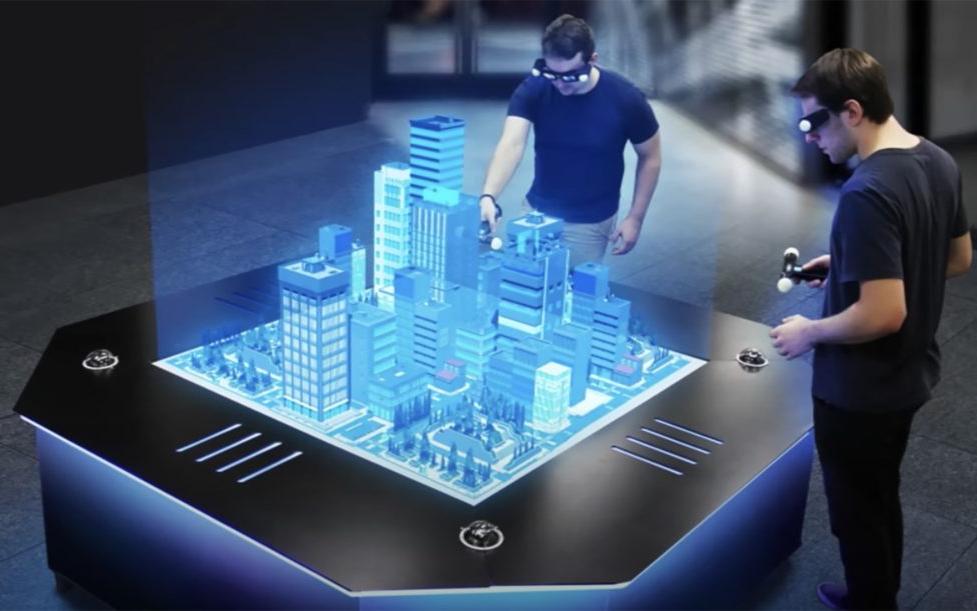
From the technological perspective associated with deepseekplay com, combining AI with immersive interfaces opens opportunities for more personalized digital experiences. An intelligent virtual assistant could present relevant information within a three-dimensional workspace instead of displaying conventional notification windows. Similarly, an educational application could adjust the complexity of a virtual demonstration according to a student’s progress, creating a more responsive learning environment.
Natural Language and Gesture Recognition
Future interfaces could combine conversational AI with gesture recognition to reduce the number of manual steps required to complete tasks. Users may be able to request information verbally and manipulate the resulting visual content through simple movements.
For example, an architect could ask an AI assistant to display an alternative building design, rotate the virtual structure, and compare different construction materials. Such interactions would combine visual understanding with natural communication, potentially improving efficiency in complex workflows.
Traditional Interfaces vs Holographic Interfaces
The transition toward immersive computing introduces several differences in how information is displayed, controlled, and understood. The following comparison highlights the potential advantages and practical distinctions between conventional and holographic interfaces.
| Feature | Traditional Interfaces | Holographic Interfaces |
|---|---|---|
| Visual presentation | Two-dimensional screens | Three-dimensional visualization |
| Input methods | Keyboard, mouse, and touch | Gestures, voice, and spatial controls |
| User engagement | Screen-based interaction | Immersive interaction |
| Information display | Fixed digital workspace | Spatially arranged information |
| Collaboration | Documents and video calls | Shared virtual environments |
| Hardware requirements | Standard computing devices | Advanced optics and sensors |
| Accessibility | Widely established | Developing accessibility solutions |
| Technology maturity | Commercially mature | Emerging and evolving |
Traditional interfaces remain highly effective for everyday computing tasks, particularly those involving text, spreadsheets, and routine communication. Holographic interfaces may offer greater value when spatial understanding, visualization, and interactive demonstrations are essential.
Major Applications of Holographic Interfaces
Holographic and related immersive technologies have potential applications across numerous industries. Their greatest advantage lies in presenting complex information in ways that may be difficult to achieve through conventional displays. The growing interest in deepseekplay com and emerging digital innovations demonstrates the relevance of exploring these industry-specific opportunities.
Healthcare and Medical Education
Healthcare professionals could use three-dimensional visualization to examine anatomical structures, study medical imaging data, and prepare for complex procedures. Medical students may benefit from interactive representations of organs and biological systems, allowing them to understand spatial relationships more effectively than traditional illustrations alone.
However, clinical applications require extensive validation, accurate medical data, regulatory compliance, and reliable hardware. Holographic visualization should complement professional medical judgment rather than replace established diagnostic methods.
Education and Professional Training
Immersive learning environments could help students understand subjects involving complex structures, scientific processes, and historical environments. Instead of relying exclusively on textbooks, learners could examine interactive molecular models, explore virtual planetary systems, or study mechanical equipment in three dimensions.
Professional training could also become more practical through interactive simulations. Employees learning to operate sophisticated machinery might practice using virtual equipment before working with physical systems, potentially reducing training-related risks and material costs.
Entertainment and Gaming
The entertainment industry offers considerable opportunities for immersive digital interaction. Future gaming systems could display virtual characters and environments that appear integrated with physical surroundings, allowing players to experience storytelling from different perspectives.
Live events, exhibitions, and interactive performances could also incorporate holographic-style presentations. Nevertheless, many entertainment experiences currently marketed as holograms rely on projection techniques or optical illusions rather than true holographic reconstruction.
Business and Remote Collaboration
Organizations increasingly depend on digital communication to connect distributed teams. Holographic-style collaboration could make remote meetings more interactive by enabling participants to examine shared three-dimensional models, review product prototypes, and discuss spatial designs.
Industries such as architecture, manufacturing, engineering, and product development may find these capabilities particularly useful. Employees could explore proposed designs together without requiring every participant to be physically present in the same location.
Key Benefits of Holographic Interfaces
The potential advantages of holographic interfaces extend beyond visual appeal. By combining spatial information with intelligent interaction, these technologies could make certain digital tasks more intuitive and efficient.
Some important potential benefits include:
-
Improved understanding of complex three-dimensional information.
-
More immersive educational and professional training experiences.
-
Enhanced remote collaboration and product visualization.
-
Reduced dependence on conventional input devices.
-
Greater flexibility in organizing digital workspaces.
These advantages will depend on the quality of implementation, affordability, user comfort, and the suitability of holographic interaction for specific tasks.
The Connection Between Spatial Computing and Holography
Spatial computing allows digital systems to understand physical environments and position virtual information within them. It combines technologies such as environmental mapping, motion tracking, computer vision, and interactive three-dimensional rendering. Holography could contribute to this ecosystem by improving how virtual information is visually represented.

The future interaction landscape explored through deepseekplay com becomes particularly relevant when considering how digital workspaces may extend beyond individual screens. Users could potentially organize applications around their surroundings, inspect virtual objects at realistic scales, and access contextual information while performing physical activities. However, widespread adoption will require reliable environmental tracking and carefully designed interaction standards.
Challenges Facing Holographic Interface Development
Despite their potential, holographic interfaces face considerable technological and commercial challenges. Generating high-quality three-dimensional images requires sophisticated optical components and substantial computational resources. Maintaining consistent visual performance while users move or interact with digital content introduces additional complexity.
Cost is another important consideration. Advanced display systems and specialized sensors can make immersive hardware expensive, limiting accessibility for consumers and smaller organizations. Developers must also address energy consumption, device portability, software compatibility, and the availability of useful applications before holographic interfaces can become mainstream.
Privacy and Data Security Concerns
Immersive systems may collect sensitive information about users and their surroundings, including movement patterns, voice recordings, eye-tracking data, and environmental scans. Without appropriate safeguards, such information could create significant privacy risks.
Future holographic systems should prioritize transparent data collection, secure processing, clear permission controls, and responsible information management. Businesses developing these technologies must ensure that immersive convenience does not come at the expense of user privacy or security.
User Comfort and Accessibility
An interface cannot be considered successful simply because it offers advanced visual capabilities. Extended use should remain comfortable, and interaction methods must accommodate individuals with different physical and sensory abilities.
Developers need to consider alternative input methods, adjustable visual settings, readable text, and reduced motion options. Accessible design will be essential for ensuring that holographic technologies serve a broad range of users rather than a limited audience.
The Current State of Holographic Technology in 2026
As of November 2026, holographic display research continues to advance alongside augmented reality, mixed reality, artificial intelligence, and spatial computing. Researchers are investigating improved optical systems, efficient computational holography, realistic depth representation, and faster three-dimensional rendering. These developments demonstrate meaningful progress, although several engineering limitations remain.
The technological discussions surrounding deepseekplay com are particularly relevant in an environment where immersive computing is receiving increasing attention. Nevertheless, commercially available mixed-reality experiences should not be confused with unrestricted, interactive holograms projected into open space. Many existing systems still require headsets, specialized screens, controlled lighting conditions, or dedicated optical equipment.
How Holographic Interfaces Could Change Everyday Life
Future holographic interfaces could influence how individuals manage information, communicate, shop, learn, and organize their homes. A digital workspace might allow users to arrange applications around a desk, while intelligent household systems could present contextual information through spatial displays.
Online shopping could also become more interactive through realistic product visualization. Customers might examine furniture at its approximate physical size before purchasing or inspect virtual product models from multiple angles. Although related augmented reality applications already exist, future holographic technologies could improve the realism and flexibility of these experiences if practical display limitations are overcome.
Future Trends in Holographic Interaction
The future development of holographic interfaces will likely depend on improvements across multiple technological fields rather than a single breakthrough. Artificial intelligence, computational optics, advanced processors, and energy-efficient hardware could collectively support more practical immersive systems.
Important developments to watch include:
-
Smaller and more energy-efficient holographic display systems.
-
AI-powered real-time three-dimensional content generation.
-
Improved gesture recognition and conversational interaction.
-
More accessible immersive workplace and educational applications.
-
Better visual quality, viewing flexibility, and user comfort.
As interest in technologies associated with deepseekplay com continues, the practical value of these developments will depend on whether they solve genuine problems and deliver meaningful improvements over existing interfaces.
Will Holographic Interfaces Replace Traditional Screens?
Holographic interfaces are unlikely to eliminate conventional screens entirely in the foreseeable future. Traditional displays are affordable, portable, energy-efficient, and suitable for numerous everyday activities. Reading documents, writing emails, managing spreadsheets, and performing routine administrative work do not necessarily require immersive visualization.
A more realistic future involves different interface technologies working together. Conventional screens could remain essential for straightforward computing tasks, while holographic and spatial interfaces could support activities that benefit from realistic depth, interactive visualization, and collaborative environments. Users would have greater flexibility to choose the most appropriate interface for each situation.
Conclusion
Holographic interfaces represent an exciting direction in the evolution of human-computer interaction. By combining advanced display technologies, artificial intelligence, spatial computing, and natural input methods, these systems could transform how people understand information and engage with digital environments. Healthcare, education, entertainment, manufacturing, and remote collaboration are among the sectors that may benefit from their continued development.
The future interaction landscape discussed in connection with deepseekplay com highlights the importance of balancing technological innovation with practical usability. Although affordability, privacy, accessibility, and hardware limitations remain significant challenges, continued research could make immersive interfaces increasingly valuable. Ultimately, the success of holographic technology will depend not merely on creating impressive visual experiences but on making digital interaction more intuitive, productive, secure, and meaningful for everyday users.

